How the 2027 Chevrolet Bolt’s Standard NACS Port Simplifies Public Charging Around Ontario, CA
Orel Hershiser Chevrolet – How the 2027 Chevrolet Bolt’s Standard NACS Port Simplifies Public Charging Around Ontario, CA
The 2027 Chevrolet Bolt takes the guesswork out of public charging with a standard NACS charge port and DC Fast Charging capability designed to make everyday driving and weekend getaways more seamless. For Ontario residents who split time between errands at the mall, school runs across town, and freeway hops into neighboring communities, the Bolt’s compatibility with a wider range of public chargers—including many Tesla Superchargers—can turn an impromptu top-off into a simple, short stop. Pair that with an EPA-estimated 262 miles of range and a GM-estimated 10–80% DC Fast Charge in about 25 minutes at a compatible station, and you have a blueprint for planning drives with confidence, not compromise.
In practice, NACS standardization reduces friction. Instead of sorting through adapter scenarios or skipping a charger that doesn’t fit, you can focus on the stations that match your route and schedule. Around Ontario and the Inland Empire, that flexibility is meaningful. You might start your day with a substantial charge at home, then add enough energy at a public site near the office to handle an evening detour across the valley. Or, if your schedule is fluid, the broader NACS-enabled map can help you quickly pivot when the closest charger is occupied. It’s a practical, everyday kind of convenience—one that naturally pairs with the Bolt’s intuitive 11.3-inch touchscreen and Google built-in for streamlined navigation and charger discovery.
- Wider access: Standard NACS opens up more public charging options, including many Tesla Superchargers.
- Faster turnarounds: A GM-estimated 10–80% top-off in about 25 minutes at a compatible DC Fast Charger fits between errands.
- Smarter routing: Google built-in can surface compatible stations on the fly, minimizing detours.
- Future-ready: As networks evolve, standard NACS supports easier adoption of new locations.
Even with a strong public network, home routines remain central. Many drivers rely on overnight charging for day-to-day needs, then treat public DC Fast Charging as a safety net for heavier weeks. Chevrolet’s guidance for the Bolt’s new battery technology notes that regularly charging to 100% is recommended to achieve the fastest overall charging speeds, making it simple to sync with your nightly schedule. When you occasionally need fast public juice, the standard NACS port and DC Fast Charging capability help you jump back on the road with minimal downtime. If you add available features like wireless phone charging, your cockpit stays tidy while you let the car and charger do the work.
Charging peace of mind goes beyond connectors and kilowatts. Over 20 standard safety and driver assistance features, including helpful systems like Adaptive Cruise Control, Front and Rear Park Assist, and IntelliBeam®, are on your side as you navigate the flow of the Inland Empire. On longer freeway stints, available Super Cruise® brings hands-free capability to compatible roads, easing fatigue when traffic backs up through interchanges. Inside, the 11-inch Driver Information Center keeps state-of-charge and drive data front and center, so range planning is straightforward and predictable, even if your day heads in a new direction.
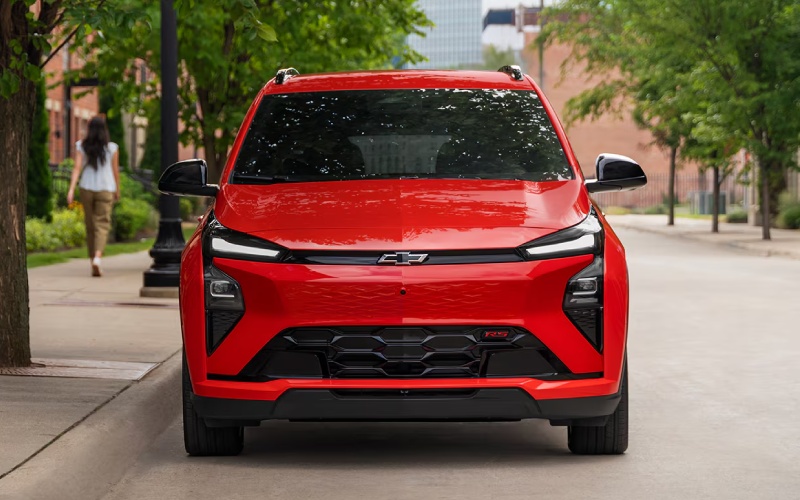
For many Ontario families, storage flexibility is equally vital. The redesigned console offers easier everyday use, and the underfloor cargo area—up to 4 cu. ft.—is perfect for stowing cables, a small emergency kit, or items you’d rather keep out of sight while parked at a public charger. If you prefer a sportier aesthetic, the RS trim adds a unique grille, 17-inch Black wheels, Gloss Black roof rails, Evotex seating with Red stitching, and available multi-color ambient lighting—details that elevate daily charging stops into a more refined experience.
Etiquette matters at busy fast-charging sites. Try to move your car when your target charge level is reached, and use apps or the vehicle’s built-in route planning to pick stations with available hardware. The Bolt’s NACS compatibility pays dividends here: more options typically mean less time waiting. When the weather warms or cools significantly, the car’s thermal management system can influence charge rates to balance battery health and speed. Planning a few extra minutes in extreme conditions is a smart practice, but most days around Ontario—with relatively moderate temperatures—charging proceeds briskly.
What about road trips beyond the Inland Empire? The Bolt’s 262-mile range and access to an ever-expanding network, including many Tesla Superchargers, help string together scenic drives with logical charging breaks. Whether you aim west toward the coast or east into the desert, the combination of standard NACS and fast charging supports flexible itinerary building. And with available HD Surround Vision for easier maneuvering in busy lots, plus standard driver assistance features, detours into unfamiliar areas feel more manageable.
When questions come up—about planning charging at home versus work, choosing between LT and RS, or weighing the advantages of available Super Cruise®—you deserve guidance that’s clear and practical. Orel Hershiser Chevrolet provides knowledgeable support grounded in how local drivers actually move. Our team is focused on making EV ownership comfortable from day one, so you can enjoy the calm, near-silent acceleration that defines the Bolt and fit charging naturally into your life.
Frequently Asked Questions:
Do I need an adapter to use Tesla Superchargers?
The Bolt’s standard NACS charge port is designed for broad compatibility, including many Tesla Superchargers. Always check your route planner or station details to confirm connector support and power levels.
How long should I plan to stop at a DC Fast Charger?
At a compatible high-power DC Fast Charger, a GM-estimated 10–80% top-off can take about 25 minutes. If you start with more charge or only need a short boost, your stop can be even shorter.
Will public charging hurt the battery?
The Bolt’s battery management system monitors charging to balance performance and longevity. Regularly charging to 100% is recommended to achieve the fastest overall charging speeds, and the car will manage fast-charging profiles to protect the pack.
Can the Bolt plan charging stops automatically?
With Google built in, you can surface compatible stations along your route and navigate directly. The system helps you weigh charge levels and travel time for an efficient plan.
What if I mostly drive short distances?
That’s where the Bolt shines. Many owners simply plug in at home and use public charging as a convenient backup. The standard NACS port ensures options are nearby when plans change.
When you’re ready to make charging as predictable as your morning coffee run, our team—serving Ontario, Montclair, and Eastvale—can help you map an approach that fits your home setup, commute, and weekend plans. From a quick overview of station types to tips on how to get the most from the Bolt’s driver displays and charging screens, we’ll set you up to hit the ground running with the simplest public-charging story yet.
0 comment(s) so far on How the 2027 Chevrolet Bolt’s Standard NACS Port Simplifies Public Charging Around Ontario, CA